


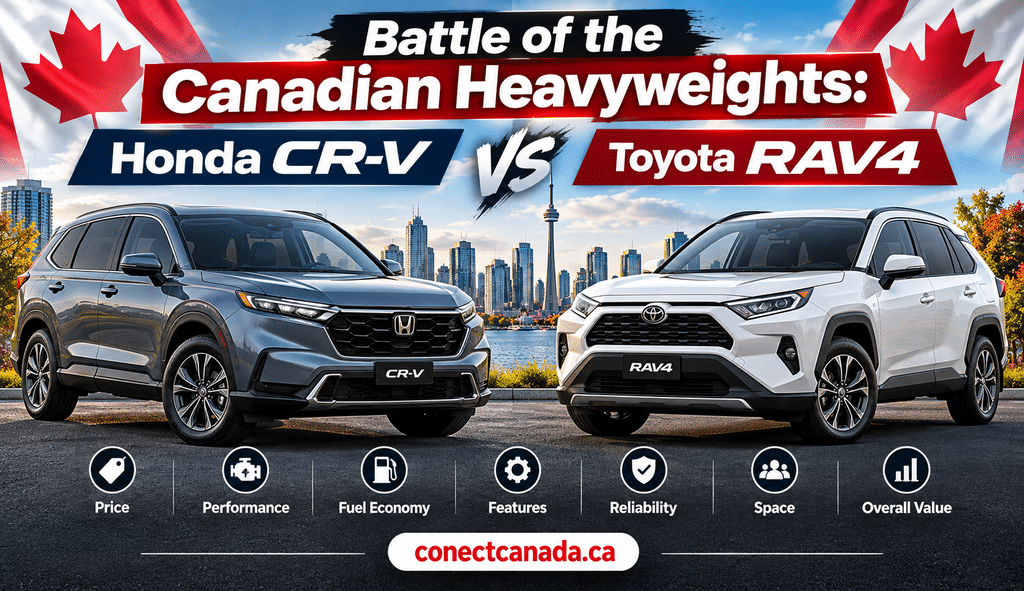
For years, the Honda CR-V vs. Toyota RAV4 have battled for supremacy as Canada’s favorite compact SUVs. Both are proudly built right here in Ontario, making them uniquely attuned to Canadian driving habits.
If you are shopping for a family crossover to tackle unpredictable Canadian weather, choosing between them comes down to three crucial categories: winter capability, pricing structures, and real-world fuel economy.
Contents
1. Canadian Winter Driving & Performance
When January hits and the roads turn to a slushy, icy mess, both of these SUVs are highly capable, but they handle power distribution very differently.
Honda CR-V: Smooth & Predictive
- The AWD System: The CR-V utilizes a mechanical real-time AWD with the Intelligent Control System™. It constantly sends a portion of power to the rear wheels during acceleration and detects front-wheel slippage before it happens, smoothly engaging the rear axle.
- Winter Comforts: Honda treats Canadians well; heated front seats and a heated steering wheel come standard on almost every trim. It also features a dedicated “Snow Mode” that softens throttle response so you don’t spin your tires on fresh ice.
- Ground Clearance: 198 mm (7.8 inches), plenty for navigating unplowed suburban side streets.
Toyota RAV4: Robust & Mechanical
- The AWD System: Non-hybrid RAV4s use a mechanical AWD system, whereas Hybrid models feature Electronic On-Demand AWD (AWD-i). Instead of a driveshaft running to the back, it uses a dedicated electric motor to power the rear wheels instantly when slipping is detected.
- Winter Comforts: Standard models get heated front seats, but you have to climb higher up the trim ladder (or opt for cold-weather packages) to unlock the heated steering wheel and heated rear seats.
- Ground Clearance: Slightly higher at 206 mm (8.1 inches) on most trims, giving it a tiny advantage over deep snowbanks.
Winter Verdict: The Honda CR-V offers a more predictable, car-like handling experience on ice and better standard cold-weather interior features. However, the RAV4’s extra ground clearance and instant rear-motor engagement on hybrid models make it a beast at pulling out of deep snow.
2. Fuel Economy: Gas vs. Hybrid
With fuel prices fluctuating across Canada, efficiency is a massive deciding factor. Both vehicles offer standard gas engines and highly efficient hybrid options. Toyota also takes it a step further by offering the RAV4 Plug-in Hybrid (PHEV), which allows for pure electric commuting.
| Powertrain Type | Honda CR-V (L/100 km) | Toyota RAV4 (L/100 km) | Winner |
|---|---|---|---|
| Standard Gas (AWD) | City: 9.1 / Hwy: 7.6 / Comb: 8.4 | City: 8.7 / Hwy: 6.9 / Comb: 7.9 | Toyota RAV4 |
| Hybrid (AWD) | City: 6.0 / Hwy: 6.9 / Comb: 6.4 | City: 5.1 / Hwy: 6.0 / Comb: 5.5 | Toyota RAV4 |
| Plug-in Hybrid (PHEV) | Not Available | Comb: 2.5 (+68 km EV Range) | Toyota RAV4 |
Fuel Economy Verdict: Toyota wins the efficiency battle. The RAV4 Hybrid’s planetary eCVT system is slightly more dialed-in for fuel savings than Honda’s dual-motor hybrid setup. Furthermore, if you want a plug-in hybrid to eliminate your daily fuel burn, Toyota is your only choice here.
3. Canadian Pricing & Value Structure
While both vehicles start at similar price points, how features are bundled across their trim lineups differs significantly.
(Note: Prices are estimated base MSRPs in Canadian dollars, excluding freight, PDI, and regional taxes).
2026 Honda CR-V Pricing:
- Base Gas (LX 2WD): Starts around $36,975 CAD
- Mid-Tier (Sport AWD): Starts around $43,375 CAD
- Top-Tier (Touring Hybrid AWD): Starts around $54,340 CAD
- Key Value Note: Honda reserves its highly desired hybrid powertrain for its more expensive, upper trims (Sport Hybrid and Touring Hybrid).
2026 Toyota RAV4 Pricing:
- Base Gas (LE AWD): Starts around $37,500 CAD (Note: Toyota includes AWD standard on base Canadian trims).
- Mid-Tier (XLE AWD): Starts around $41,300 CAD
- Top-Tier (Limited AWD / PHEV): Ranges from $52,000 to $59,350 CAD
Key Value Note: Toyota allows you to add the hybrid powertrain to almost any trim level (including the budget-friendly LE and XLE), making hybrid technology much more accessible to everyday buyers.
Pricing Verdict: Toyota offers better value packaging. Because Toyota offers standard AWD on its base Canadian models and allows you to buy a “cheap” hybrid, it is easier on the wallet. Honda forces you into higher-end, premium trims if you want the hybrid powertrain.
Which Should You Buy?
Choose the Honda CR-V if:
You prioritize cabin space, rear legroom, and premium interior comfort. The CR-V feels more luxurious inside, rides quieter on the highway, and comes standard with the cold-weather essentials (like a heated steering wheel) earlier in the lineup.
Choose the Toyota RAV4 if:
You want maximum fuel savings and flexibility. If your goal is to buy an affordable hybrid, get the absolute best fuel economy ratings, or invest in a Plug-in Hybrid (PHEV) that can handle deep Canadian winters without breaking a sweat, the RAV4 is the undisputed king.
Also Visit: Conquest Knight XV Price in Canada, Specifications, Features & Review (2026 Guide)
Find Any Phone Number in Canada. Find the phone number of any company, organization, bank, or department here. Celebrity, NGO, Institute, School, College, University, Government Hospital, Private Hospital, Government Office, & Couriers. Also find the insurance plans, car prices, and loan calculator on ConectCanada.ca